
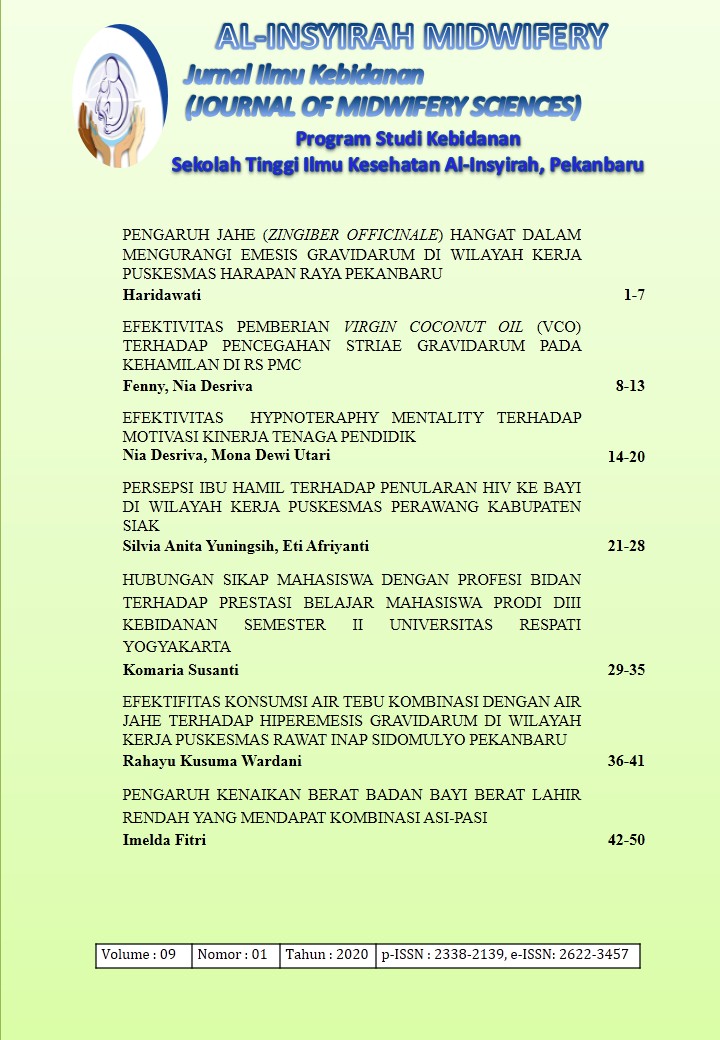
EFEKTIVITAS HYPNOTERAPHY MENTALITY TERHADAP MOTIVASI KINERJA TENAGA PENDIDIK
Tenaga Pendidik, Motivasi, Hypnotherapy Mentality
DOI:
https://doi.org/10.35328/kebidanan.v9i1.547Keywords:
Educators, Motivation, Hypnotherapy MentalityAbstract
Educators are professionals who are tasked with planning and implementing the learning process, assessing learning outcomes, conducting mentoring and training, and conducting research and community service, especially for educators at tertiary institutions. Sharpening and awakening the basic mentality of educators to have a positive character is very necessary for the progress and harmonization of the world of work so that the emergence of good work motivation. Hypnotherapy is an intervention technique by utilizing empowerment through the subconscious, providing positive suggestions in building strong mental and positive thoughts so as to increase work motivation. This study uses a Quasi-Experiment (Quasi Experiment) method with a Pre and Post Test with Non Control Design. The population in this study were teaching staff in institutions or universities, the research sample was taken using a purposive sampling technique with 32 teaching staff, 16 people for the intervention group or who were given treatment and 16 people for the control group who were not given treatment. Based on the effect test using Paired sample T-test in the experimental group showed the results of p = 0,000 <0.05 and in the control group p = 0.164 <0.05. This shows the effectiveness of the implementation of hypnotensive mentality on the performance motivation of PMC STIKes teaching staff.
Downloads
References
 New Template artikel